The State of Education in the United States
America is suffering from poor educational outcomes. There’s no way around that.
According to the National Institute on Literacy, 54% of adults have literacy skills below a 6th grade level. Low literacy rates are having huge implications for the U.S. economy. In 2022, 3 out 4 people on welfare couldn’t read and 3 out of 5 people in American prisons couldn’t read.
America isn’t just suffering from low literacy rates though, the United States is also falling behind China and India in the fields of Science, Technology, Engineering, and Mathematics. China graduated 3.57 million students in STEM in 2020, India graduated 2.55 million, and the United States graduated 820,000 students according to the Center for Security and Emerging Technology. Something is wrong with our education system. Does it have anything to do with bad teachers?
The Role of Good vs. Bad Teachers in Student Success
Neil deGrasse Tyson once tweeted in 2015 that, “Students who earn straight ‘A’s in school do so not because of good teachers but in spite of bad teachers.” He later explained in an interview that he meant that there are students who do well in any classroom, in any academic setting, no matter what, no matter the quality of the teacher. There are also students who do poorly in any classroom, in any academic setting, no matter what, no matter the quality of the teacher. However, “For most people a good teacher enables them to do better and a bad teacher they don’t do as well,” he said.
I feel like Tyson’s statements are an accurate reflection on the state of teachers in this country. There are certainly excellent teachers, working day in and day out, before school and after school, to give their students the best shot at succeeding. They are tired, they are burnt-out, but they keep going, because that’s how much they care about their students.
On the flip side, there are other teachers who are tired and burnt-out and have completely lost their passion and drive for teaching. These teachers may be perceived by the public as “bad teachers”. These “bad teachers” may still care about their students, but they don’t have the capacity to burn themselves out even more on students who don’t put the effort in or under administrations that don’t support their classroom needs.
You see there are plenty of people who go through the public school system from kindergarten through twelfth grade and go on to be highly successful at Ivy League Universities, in STEM fields, as lawyers, as doctors, as business leaders and politicians. Tyson might argue that their success has nothing to do with the public school system and all with their intrinsic motivation, but I think that’s selling American schools and teachers a little short. A student may be highly intelligent and highly driven to succeed, but that doesn’t mean effective teachers and programs didn’t shape them into the learners they became.
Some of those same teachers in those same schools, may also have students that end up struggling in life because their lack of literacy and math skills prevent them from succeeding in a career that pays a living wage. Does that mean their teachers were all or largely ineffective or bad? Any logical person would tell you that we cannot base the effectiveness or value of a teacher, or school, on the success of a few or the failure of a few. Additionally, there are so many factors at play when it comes to educational outcomes aside from effective classroom teaching.
Factors That Affect Student Achievement Beyond the Classroom
We know that people with higher IQ scores tend to earn higher incomes. We also know that students who have the advantage of living in a two-parent home are more likely to graduate college and have higher earnings as adults according to labor economist, Melissa Kearney. We know that poor mental health can impair cognitive performance. We know that just through the displacement effect alone, excessive screen time can impact academic performance, not to mention the possible effects screen time has on attention spans or social-emotional regulation.
The problem is we don’t talk about all these factors when we talk about poor educational outcomes for American students, we put all the blame on what happened or didn’t happen in the classroom. There’s this idea, in the United States, that we, as a country, can fix any public problem through our schools. This puts an immense amount of pressure on teachers, who are fighting against all these other external factors.
Maybe we have poor educational outcomes in the United States, not because of bad teachers, but because the general public doesn’t actually care that much about education. If students see that their families don’t value education, why should they? Parents sometimes view school as free childcare and meals for their children instead of as an academic institution. Additionally, students can see that right-wing leaders continue to devalue education at every level from early childhood education to graduate school through their words and policies. (By the way, we don’t have time to indoctrinate your kids in elementary school, we’re busy teaching them all the prerequisite skills their parents didn’t, sometimes even like how to use the bathroom.)
Public Perception of Teachers in the United States
Teachers often feel like they are one of the most scrutinized occupational groups in the country, so I conducted a small survey to better understand public perceptions of teachers. I asked 28 random participants ranging from ages 19 to 39 in the United States to answer a survey on their satisfaction with teachers.
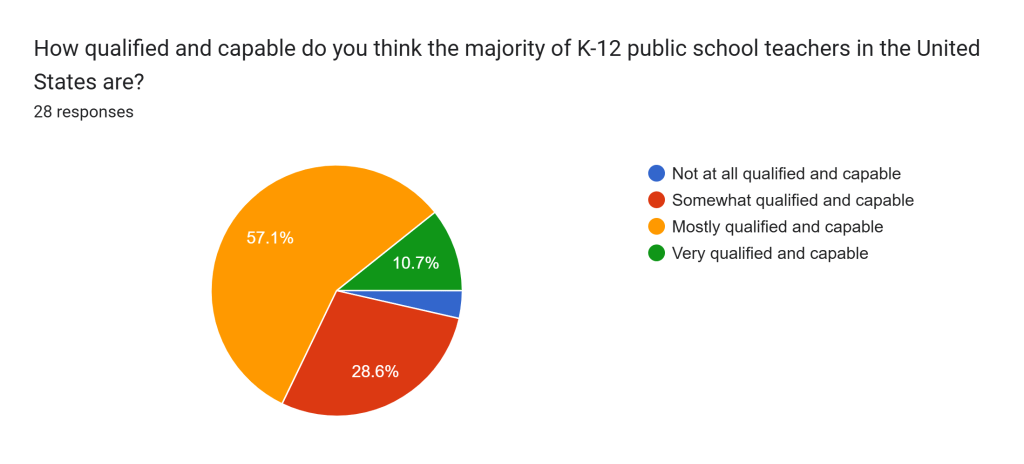
First, I asked participants how qualified and capable they thought the majority of K-12 public school teachers in the United States were, ranging from not at all qualified and capable to very qualified and capable. A large majority of respondents, at 67.8%, said that the majority of K-12 teachers were either “Mostly qualified and capable” or “Very qualified and capable”.
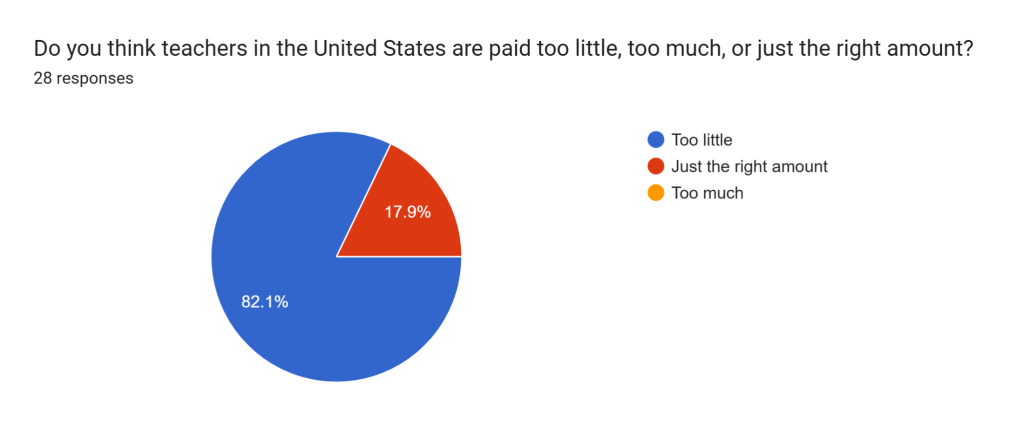
Then, I asked participants if they thought teachers were paid too little, too much, or just the right amount. The large majority of respondents, at 82.1%, said that teachers were paid too little. No respondents said that teachers were paid too much.
So far, the results of my survey were looking pretty good for teachers, most people thought that America’s teachers are qualified and capable, yet receive too little pay. Next, I asked participants if they thought low-quality teachers were a contributing factor to poor educational outcomes for American students, 70.4% of respondents said they were. Additionally, 71.4% of respondents said the qualifications (education and experience) should be more rigorous for K-12 teachers in the United States.
Finally, I asked participants how hard-working they considered America’s teachers to be in general on a scale of 1 to 5, one being “not at all hardworking” and five being “very hardworking”. Overall, teachers scored well on this component with 82.1% of respondents choosing a score of 4 (fairly hardworking) or 5 (very hardworking).
What I draw from these results is that teachers are more appreciated than they think by the American public. However, most Americans also think the school system could be improved by raising the qualifications to become a teacher. The public also acknowledges that teachers who are not performing up to a certain standard could be impacting the success of students.
The question remains, can we improve educational outcomes in the United States through better teachers? And if that’s the case, how do we get and retain better teachers?
How the U.S. Education System Compares to Denmark
First, we have to take a look at how American teachers differ from teachers of other more high-performing countries. The Scandinavian countries of Denmark, Sweden, and Finland are all ranked in the top five of countries with the most “Well-developed public education systems” in the world according to the U.S. News World Report.
Surprisingly though, the qualifications to become a teacher in Denmark are not all that different from the qualifications to become a teacher in the United States. In Denmark, students must complete a four-year teaching degree, specialize in three subjects, and complete an extensive practicum, kind of like student teaching in America. Admissions to these programs are competitive, but not highly elite. The GPA requirements for these programs would be around B or B+ averages for American students. Apparently though, interviews and written reflections may be a part of the admissions process for prospective students. These processes are to help determine if a person’s personality matches the role of being a teacher.
The typical salary for a teacher in Denmark ranges from 50,000 to 80,000 U.S. dollars a year which is pretty much the same as teachers in my state of Pennsylvania. Teachers in Denmark pay higher taxes on their salaries, but benefit from free healthcare, free colleges, and a good pension.
While the requirements to become a teacher are similar between Denmark and the United States, the education systems are not.
For example, in the first four years of public school for Danish students the school day only lasts 4-6 hours a day, As students get older they work up to a 7-8 hour day, Students attend school for about 200 days a year which is slightly more than for students in the U.S. who attend for about 180 days a year.
Another key difference between the education system in Denmark compared to the United States is that there is very little standardized testing in Denmark. There is also more play in the early years of education in Denmark, especially free outdoor play.
Overall, I think the trust and autonomy teachers have in Denmark probably makes teachers more motivated, less stressed, and more holistic practitioners. I believe if we can make our education system look more like Denmark’s we will see better educational results without radically changing the way we recruit, train, and develop teachers in the United States. There are more similarities between qualifications for teachers between Denmark and the United States than there are in the education system.
Maybe we can change are mindset from there are too many “bad teachers” in America to “how can we change our system to make it one where teachers thrive”.


Leave a Reply